

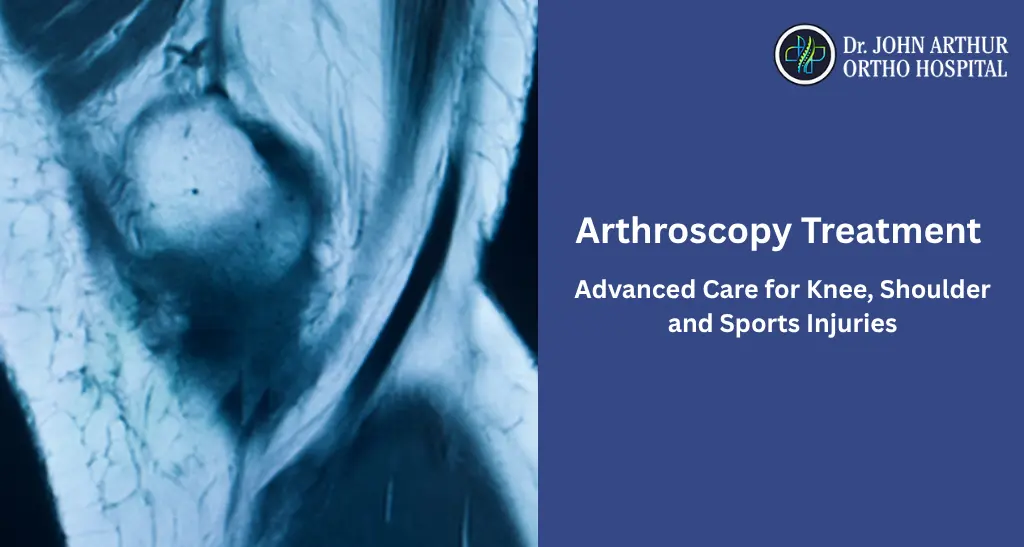
Arthroscopy is a minimally invasive Orthopaedic procedure used to diagnose and treat problems affecting joints. It is commonly performed for sports injuries, ligament tears, cartilage damage, instability and other conditions affecting the knee, shoulder, hip, ankle, elbow and wrist.
If you are searching for arthroscopy treatment in Chennai, choosing an experienced Orthopaedic surgeon and a hospital with appropriate surgical and rehabilitation facilities is important for achieving the best possible functional outcome.
At Dr. John Arthur Ortho Hospital, Avadi, Chennai, patients can receive comprehensive Orthopaedic evaluation and treatment for a wide range of joint and sports-related injuries. Dr. Peter Ponnaiah Jesudass, Orthopaedic Surgeon, provides assessment and treatment for various ligament, tendon, cartilage and joint conditions where arthroscopic surgery may be appropriate.
What Is Arthroscopy?
Arthroscopy is a minimally invasive surgical technique in which a small camera called an arthroscope is inserted into a joint through a small incision.
The camera allows the surgeon to clearly view structures inside the joint, including:
- Ligaments
- Tendons
- Cartilage
- Meniscus
- Joint surfaces
- Other soft tissues
Additional small instruments can be introduced through separate incisions to repair or treat the identified problem.
Unlike traditional open surgery, arthroscopy generally requires smaller incisions and can allow treatment of several joint conditions with less disruption to surrounding tissues.
Arthroscopy Treatment in Chennai for Knee and Sports Injuries
The knee is one of the most frequently treated joints through arthroscopic surgery.
Sports, accidents, twisting injuries and repetitive movements can cause damage to the ligaments, meniscus and cartilage of the knee.
At Dr. John Arthur Ortho Hospital, arthroscopic evaluation and treatment may be considered for a range of knee injuries.
ACL Tears
The anterior cruciate ligament or ACL is an important stabilizing ligament in the knee.
An ACL tear can occur during:
- Football
- Cricket
- Basketball
- Badminton
- Running
- Sudden twisting movements
- Road traffic accidents
Symptoms may include a popping sensation, swelling, instability and difficulty returning to sports.
For selected patients, arthroscopic ACL reconstruction may be recommended to restore knee stability.
PCL, MCL and LCL Tears
The posterior cruciate ligament, medial collateral ligament and lateral collateral ligament also contribute to knee stability.
Depending on the severity and combination of injuries, treatment may involve rehabilitation, bracing or surgical reconstruction.
Multi-Ligament Knee Injuries
High-energy trauma can sometimes damage multiple knee ligaments.
These complex injuries require detailed assessment and careful treatment planning to restore stability and function.
Meniscus Tears
The menisci are structures that help distribute load and provide cushioning inside the knee.
A torn meniscus can cause:
- Knee pain
- Swelling
- Clicking
- Catching
- Locking
- Difficulty squatting
Depending on the type and location of the tear, arthroscopic meniscus repair or other appropriate treatment may be considered.
Cartilage Defects
Damage to the cartilage covering the joint surface can cause pain, swelling and reduced function.
Arthroscopy allows the surgeon to assess cartilage damage directly and determine an appropriate treatment strategy.
Patellar Instability
Repeated dislocation or instability of the kneecap can affect athletes and active individuals.
Depending on the underlying problem, treatment may involve rehabilitation or surgical stabilization.
Sports-Induced Knee Pain
Persistent knee pain in athletes should not simply be considered a normal consequence of sports.
An Orthopaedic assessment can help identify whether the pain is related to ligament injury, meniscus damage, cartilage problems, patellar instability or another condition.
Arthroscopy for Shoulder Injuries
The shoulder has a wide range of movement, making it particularly vulnerable to instability, tendon injuries and sports-related problems.
Arthroscopy can be used to diagnose and treat several shoulder conditions.
Recurrent Shoulder Dislocation
Repeated shoulder dislocation can occur when the structures responsible for stabilizing the joint are damaged.
Arthroscopic stabilization may be recommended for selected patients, particularly athletes and active individuals experiencing recurrent instability.
Rotator Cuff Tears
The rotator cuff is a group of tendons that helps control shoulder movement.
Rotator cuff tears can cause:
- Shoulder pain
- Weakness
- Difficulty lifting the arm
- Pain at night
- Reduced shoulder function
Depending on the size and nature of the tear, arthroscopic rotator cuff repair may be considered.
SLAP and Labral Tears
The labrum contributes to shoulder stability. Injuries to the labrum, including SLAP tears, can occur in athletes and people involved in repetitive overhead activities.
Arthroscopic assessment can help determine the extent of the injury and appropriate treatment.
Frozen Shoulder
Frozen shoulder causes pain and significant restriction of shoulder movement.
Treatment is usually initially conservative, involving medication, physiotherapy and other appropriate measures. In selected cases that do not respond adequately to non-surgical treatment, arthroscopic procedures may be considered.
Biceps Tendon Tears
Injuries affecting the biceps tendon can cause pain and weakness around the shoulder.
The appropriate surgical approach depends on the location and severity of the injury and the patient’s functional requirements.
Shoulder Instability in Athletes
Athletes involved in throwing, contact or overhead sports may be particularly susceptible to shoulder instability.
A detailed assessment can help determine the cause and guide treatment and rehabilitation.
Hip and Pelvis Arthroscopy
Hip arthroscopy is a minimally invasive procedure that can be used for selected conditions affecting the hip joint.
Femoroacetabular Impingement
Femoroacetabular impingement, commonly called FAI, occurs when abnormal contact between the bones of the hip causes pain and restricted movement.
It can affect athletes and active individuals.
Hip Labral Tears
The hip labrum helps provide stability and contributes to the smooth movement of the hip joint.
A labral tear can cause:
- Groin pain
- Clicking
- Catching
- Reduced hip movement
- Pain during sports
Selected labral injuries may be treated arthroscopically.
Tendon Injuries
Tendon problems around the hip and pelvis can develop because of sports, overuse or repetitive activity.
Treatment depends on the affected tendon and severity of the injury.
Sports-Related Groin Pain
Groin pain is common among athletes involved in running, football and other sports requiring repeated changes in direction.
Identifying the exact source of pain is important because groin symptoms can have several possible causes.
Ankle Arthroscopy and Sports Injuries
The ankle can sustain ligament, tendon and cartilage injuries during sports and everyday activities.
Ankle Sprains
Ankle sprains are among the most common sports injuries.
While many sprains can be managed without surgery, recurrent symptoms or persistent instability may require further assessment.
Chronic Ankle Instability
Repeated ankle sprains can sometimes result in chronic instability.
Patients may feel that the ankle is “giving way”, particularly during sports or on uneven surfaces.
Ankle Ligament Tears
Significant ligament injuries may require structured rehabilitation and, in selected cases, surgical stabilization.
Achilles Tendon Injuries
The Achilles tendon is particularly important for walking, running and jumping.
Treatment depends on the type and severity of the injury and the patient’s functional requirements.
Cartilage Defects
Cartilage damage in the ankle can cause persistent pain, swelling and reduced function.
Arthroscopic evaluation may help assess the joint and guide appropriate treatment in selected cases.
Elbow and Wrist Arthroscopy
Arthroscopy can also be used to diagnose and treat selected conditions affecting the elbow and wrist.
Tennis Elbow and Golfer’s Elbow
These conditions involve tendon-related pain around the elbow and are often initially treated with conservative approaches such as activity modification, physiotherapy and medication.
Persistent cases may require further evaluation and, in selected patients, surgical treatment.
Thrower’s Elbow
Repetitive throwing can place significant stress on the elbow.
Athletes may develop tendon, ligament or cartilage problems that require specialist evaluation.
Ligament Injuries
Ligament injuries can affect elbow and wrist stability and may occur following sports injuries or trauma.
Tendon Tears
Tendon injuries can result from acute trauma or repetitive overuse.
The appropriate treatment depends on the location and severity of the tear.
Overuse Sports Injuries
Repeated movements can gradually overload joints, tendons and other soft tissues.
Early evaluation can help prevent a minor sports injury from developing into a persistent problem.
What Are the Benefits of Arthroscopy?
One of the reasons arthroscopy is widely used for selected Orthopaedic conditions is its minimally invasive nature.
Potential benefits can include:
Smaller Wounds
Arthroscopic surgery uses small incisions rather than the larger incision typically associated with traditional open procedures.
Reduced Post-Operative Pain
Because there is generally less disruption to surrounding tissues, some patients may experience less post-operative discomfort.
Faster Healing
Smaller surgical wounds may support a quicker recovery of the soft tissues, although overall recovery depends on the procedure performed.
Minimal Blood Loss
Arthroscopic procedures generally involve limited blood loss compared with many traditional open procedures.
Quicker Return to Mobility
Early controlled movement and rehabilitation may be possible following many arthroscopic procedures.
The timing depends on the specific repair and the surgeon’s rehabilitation protocol.
Improved Joint Stability
When arthroscopy is used to appropriately repair or reconstruct damaged structures such as ligaments, the objective is to restore joint stability and function.
Is Arthroscopy Suitable for Everyone?
No.
Arthroscopy is not automatically the best treatment for every joint problem.
The appropriate treatment depends on:
- Type of injury
- Severity of damage
- Patient’s age
- Activity level
- Duration of symptoms
- Joint condition
- Previous treatment
- Overall health
Some conditions respond very well to non-surgical treatment such as physiotherapy, medication, activity modification and rehabilitation.
An Orthopaedic consultation is therefore important before deciding whether surgery is required.
Arthroscopy vs Open Surgery
Arthroscopy and open surgery are different surgical approaches.
With arthroscopy, a small camera and specialized instruments are introduced through small incisions. Open surgery involves a larger incision to directly access the affected structures.
Arthroscopy may offer advantages such as smaller wounds and potentially faster early recovery for appropriate conditions.
However, the goal is not simply to choose the least invasive procedure. The priority is selecting the procedure that provides the best treatment for the specific injury.
Recovery After Arthroscopic Surgery
Recovery varies significantly depending on the joint and procedure.
For example, recovery after an arthroscopic meniscus procedure can be very different from recovery after ACL reconstruction or rotator cuff repair.
Rehabilitation may include:
- Pain management
- Swelling control
- Joint mobility exercises
- Muscle strengthening
- Physiotherapy
- Gradual weight-bearing
- Balance training
- Sport-specific rehabilitation
Athletes should not return to competitive sports simply because pain has reduced. Strength, stability, movement control and functional recovery should be assessed before returning to high-level activity.
Why Choose Dr. John Arthur Ortho Hospital for Arthroscopy Treatment in Chennai?
Dr. John Arthur Ortho Hospital in Avadi, Chennai, provides comprehensive Orthopaedic care for joint problems, sports injuries, ligament injuries, fractures and musculoskeletal conditions.
Patients seeking arthroscopy treatment in Chennai can undergo a detailed assessment to determine the cause of their symptoms and whether arthroscopic or non-surgical treatment is appropriate.
The hospital’s Orthopaedic services cover conditions affecting the:
- Knee
- Shoulder
- Hip
- Ankle
- Elbow
- Wrist
This allows patients with different sports and joint injuries to receive evaluation and treatment under an Orthopaedic care team.
Dr. Peter Ponnaiah Jesudass: Orthopaedic and Sports Injury Care
Dr. Peter Ponnaiah Jesudass, Orthopaedic Surgeon at Dr. John Arthur Ortho Hospital, provides evaluation and treatment for a range of Orthopaedic and sports-related conditions.
His clinical expertise includes the assessment and management of injuries involving:
- Knee ligaments
- ACL injuries
- Meniscus
- Shoulder instability
- Rotator cuff problems
- Sports injuries
- Joint and ligament conditions
- Trauma-related Orthopaedic problems
For patients with persistent joint pain, instability or a suspected ligament injury, a specialist evaluation can help determine whether physiotherapy, medication, rehabilitation or arthroscopic surgery is appropriate.
When Should You See an Arthroscopy Specialist?
Consider an Orthopaedic consultation if you experience:
- Persistent joint pain
- Repeated swelling
- Joint locking or catching
- Recurrent dislocation
- Joint instability
- Pain after a sports injury
- Difficulty returning to sports
- Persistent symptoms after an ankle sprain
- Suspected ligament or meniscus injury
- Reduced joint movement
An early assessment can help identify the injury and establish an appropriate treatment and rehabilitation plan.
Frequently Asked Questions About Arthroscopy
What is arthroscopy?
Arthroscopy is a minimally invasive procedure that uses a small camera and specialized instruments to diagnose and treat problems inside a joint.
Which joints can be treated with arthroscopy?
Arthroscopy can be performed on several joints, including the knee, shoulder, hip, ankle, elbow and wrist.
Is arthroscopy better than open surgery?
Arthroscopy can provide benefits such as smaller incisions and potentially faster early recovery for suitable conditions. However, the appropriate surgical technique depends on the specific injury and patient.
How long does it take to recover from arthroscopy?
Recovery depends on the procedure. Recovery after a simple arthroscopic procedure can be considerably shorter than recovery after ligament reconstruction or tendon repair.
Can athletes return to sports after arthroscopy?
Many athletes can return to sports after appropriate arthroscopic treatment and rehabilitation. The timing depends on the injury, procedure, healing and functional recovery.
Is arthroscopy always necessary for sports injuries?
No. Many sports injuries can be treated without surgery. An Orthopaedic specialist should assess the injury before deciding on the appropriate treatment.
Looking for Arthroscopy Treatment in Chennai?
If you are searching for arthroscopy treatment in Chennai for a knee, shoulder, hip, ankle, elbow or wrist problem, getting an accurate diagnosis is the first step.
At Dr. John Arthur Ortho Hospital, Avadi, Dr. Peter Ponnaiah Jesudass provides Orthopaedic evaluation and treatment for sports injuries, ligament tears, joint instability and other musculoskeletal conditions.
From ACL tears and meniscus injuries to rotator cuff tears, shoulder instability, hip labral injuries and ankle problems, arthroscopy can provide a minimally invasive treatment option for selected patients.
The right treatment begins with the right diagnosis. Consult an Orthopaedic specialist to understand your condition and explore the most appropriate treatment options.