

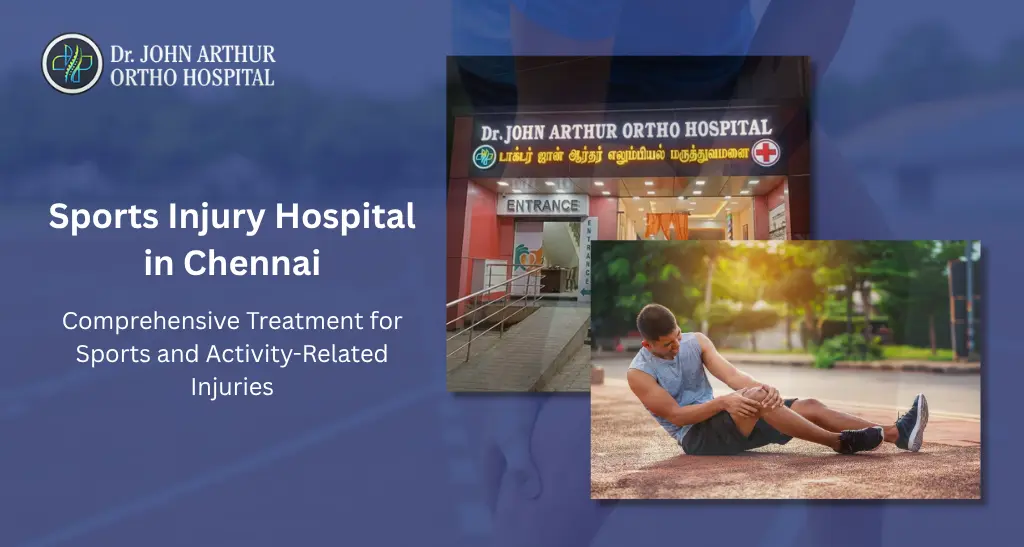
Sports injuries can happen to anyone, from professional athletes and competitive players to people who exercise regularly, run, cycle or participate in recreational activities. A sudden twist, fall, collision or repetitive movement can affect the muscles, tendons, ligaments, bones and joints.
When an injury causes persistent pain, swelling, instability or restricted movement, getting an accurate diagnosis is important. Early assessment can help determine whether the injury can be managed with physiotherapy and rehabilitation or whether a surgical procedure may be required.
If you are searching for a Sports Injury Hospital in Chennai, Dr. John Arthur Ortho Hospital in Avadi provides Orthopaedic evaluation and treatment for a wide range of sports and activity-related injuries. The hospital’s sports injury services include both non-surgical and surgical treatment, with rehabilitation forming an important part of recovery.
What Is a Sports Injury?
A sports injury is an injury that occurs during sports, exercise, physical activity or repetitive movement.
Sports injuries can affect almost any part of the musculoskeletal system, including:
- Bones
- Muscles
- Tendons
- Ligaments
- Cartilage
- Joints
Some injuries occur suddenly, while others develop gradually because of repeated stress or overuse.
Common causes of sports injuries include:
- Sudden twisting movements
- Falls and collisions
- Direct impact
- Incorrect landing
- Sudden changes in direction
- Overtraining
- Repetitive movements
- Inadequate warm-up
- Poor technique
- Returning to sport before an earlier injury has healed
Common Sports Injuries Treated at Dr. John Arthur Ortho Hospital
Sports injuries vary considerably in severity. Some can be treated with rest and physiotherapy, while others may require surgical intervention.
ACL Tears
The anterior cruciate ligament, or ACL, is one of the major stabilising ligaments of the knee.
ACL injuries are common in sports involving:
- Football
- Cricket
- Basketball
- Badminton
- Tennis
- Running
A torn ACL may cause a popping sensation, swelling, instability and difficulty participating in sports.
Depending on the injury and the individual’s activity requirements, treatment may involve rehabilitation or ACL reconstruction surgery.
PCL, MCL and LCL Injuries
The knee contains several important ligaments that contribute to stability.
Injuries to the PCL, MCL or LCL can occur following:
- Sports collisions
- Falls
- Twisting injuries
- Direct blows to the knee
Treatment depends on the severity and location of the ligament injury.
Meniscus Tears
The meniscus helps absorb shock and distribute loads within the knee.
A meniscus tear can cause:
- Knee pain
- Swelling
- Clicking
- Catching
- Locking
- Difficulty squatting
Some meniscus injuries respond to non-surgical treatment, while selected tears may require arthroscopic treatment.
Shoulder Injuries
Shoulder injuries are particularly common among athletes involved in throwing, overhead movements and contact sports.
Conditions may include:
- Rotator cuff tears
- Shoulder instability
- Recurrent shoulder dislocation
- Labral injuries
- Biceps tendon injuries
The appropriate treatment depends on the specific structure involved and the severity of the injury.
Ankle Sprains and Instability
Ankle sprains are among the most common sports injuries.
Repeated ankle sprains can sometimes result in chronic instability, causing the ankle to repeatedly “give way.”
Treatment may include:
- Rest and activity modification
- Bracing
- Physiotherapy
- Strengthening exercises
- Balance training
- Surgical stabilisation in selected cases
Muscle and Tendon Injuries
Muscle strains and tendon injuries can occur during running, jumping, throwing and other athletic activities.
Examples include:
- Hamstring injuries
- Calf strains
- Achilles tendon injuries
- Tendon tears
- Overuse tendon injuries
Treatment depends on the location and severity of the injury.
Sports Injury Treatment in Chennai: Non-Surgical Options
Not every sports injury requires surgery.
In many cases, treatment begins with conservative management based on the injury and the patient’s condition.
Treatment may include:
Rest and Activity Modification
Temporarily reducing activities that aggravate the injury can allow the affected tissues to recover.
Medication
Pain-relieving or anti-inflammatory medication may be recommended when appropriate.
Bracing and Support
Braces or other forms of support may be used for selected ligament and joint injuries.
Physiotherapy
Physiotherapy plays an important role in sports injury recovery.
A rehabilitation programme may focus on:
- Improving flexibility
- Restoring joint movement
- Strengthening muscles
- Improving balance
- Correcting movement patterns
- Gradually increasing activity levels
Sports-Specific Rehabilitation
Athletes often need more than basic pain relief before returning to their sport.
Sports-specific rehabilitation can progressively prepare the body for movements such as:
- Running
- Jumping
- Landing
- Pivoting
- Throwing
- Direction changes
When Is Sports Injury Surgery Required?
Surgery is not necessary for every sports injury.
However, it may be considered when there is significant structural damage or when appropriate non-surgical treatment does not provide adequate improvement.
Examples may include selected cases of:
- ACL tears
- Meniscus tears
- Rotator cuff tears
- Recurrent shoulder dislocation
- Significant ligament injuries
- Tendon tears
- Certain sports-related fractures
The decision should be based on the injury, clinical examination, imaging findings, activity level and individual recovery goals.
Arthroscopy for Sports Injuries
Arthroscopy is a minimally invasive surgical technique that uses a small camera to examine and treat problems inside a joint.
It may be used for selected injuries affecting the:
- Knee
- Shoulder
- Hip
- Ankle
- Elbow
- Wrist
Depending on the procedure, arthroscopy can be used for conditions such as ACL injuries, meniscus tears, shoulder instability, rotator cuff problems and cartilage injuries.
The hospital provides arthroscopic evaluation and treatment for a range of joint and sports-related conditions.
Benefits of Arthroscopic Treatment
When arthroscopy is appropriate, potential benefits can include:
- Smaller surgical incisions
- Less disruption to surrounding tissues
- Reduced blood loss
- Potentially less post-operative discomfort
- Earlier mobility in appropriate procedures
- Rehabilitation focused on restoring joint function
Recovery varies considerably depending on the procedure. Recovery following a simple arthroscopic procedure may be very different from recovery following ACL reconstruction or tendon repair.
Diagnosis Is the First Step
Treating a sports injury without knowing the exact cause can sometimes delay recovery.
A sports injury assessment may include:
Clinical Examination
The Orthopaedic specialist evaluates pain, swelling, movement, strength and joint stability.
Imaging
Depending on the suspected injury, imaging such as X-rays or MRI may be recommended.
Functional Assessment
For athletes, understanding how the injury affects movement and sport-specific activities can help guide rehabilitation.
The objective is to identify the actual source of the problem and create an appropriate treatment plan.
Why Early Treatment Matters
Ignoring a sports injury because the pain seems manageable can sometimes allow the underlying problem to persist.
Early assessment can help:
- Identify significant ligament or tendon injuries
- Reduce unnecessary delay in treatment
- Guide appropriate rehabilitation
- Restore strength and mobility
- Reduce the risk of recurrent injury
- Help athletes return to activity safely
This does not mean every injury requires immediate surgery. In many cases, appropriate conservative treatment and rehabilitation are sufficient.
Rehabilitation After Sports Injury
Recovery does not necessarily end when pain decreases.
A structured rehabilitation programme may be necessary to restore:
Mobility → Strength → Balance → Stability → Sport-specific function
For athletes, returning to competition too early may increase the risk of reinjury.
The timing of return to sport should therefore depend on functional recovery rather than simply the number of days or weeks since the injury.
Return to Sports After an Injury
Returning to sports should generally be gradual.
Depending on the injury, an athlete may need to demonstrate adequate:
- Range of movement
- Muscle strength
- Joint stability
- Balance
- Coordination
- Sport-specific movement
- Confidence in the injured limb or joint
An Orthopaedic specialist and physiotherapy team can guide the progression.
Dr. Peter Ponnaiah Jesudass: Sports Injury Care in Chennai
Dr. Peter Ponnaiah Jesudass, Consultant Orthopaedic & Trauma Surgeon at Dr. John Arthur Ortho Hospital, provides evaluation and treatment for sports injuries, joint injuries, ligament problems and other musculoskeletal conditions.
His areas of Orthopaedic care include sports injuries, ligament injuries, fracture and trauma management, joint conditions and surgical as well as conservative treatment.
For athletes and active individuals, treatment can be planned according to the nature of the injury, functional requirements and recovery goals.
Sports Injury Hospital in Avadi, Chennai
Dr. John Arthur Ortho Hospital is located in Avadi on Poonamallee–Avadi High Road, Chennai, and provides Orthopaedic care for patients from Avadi and surrounding areas.
The hospital’s sports injury services cover both acute injuries and overuse conditions, with treatment ranging from conservative management and physiotherapy to surgical procedures when required.
The hospital also provides Orthopaedic care for patients from areas including Ambattur, Mogappair, Poonamallee, Thirumullaivoyal and Pattabiram.
When Should You See a Sports Injury Specialist?
You should consider an Orthopaedic evaluation if you experience:
- Severe pain following a sports injury
- Significant swelling
- A popping sensation during an injury
- Joint instability
- Repeated ankle sprains
- Knee giving way
- Difficulty bearing weight
- Restricted joint movement
- Persistent pain despite rest
- Recurrent injuries
- Inability to return to your normal sport or exercise
A specialist assessment can help determine whether you need rest and rehabilitation, medication, physiotherapy or further intervention.
Why Choose Dr. John Arthur Ortho Hospital for Sports Injury Treatment?
Patients looking for a Sports Injury Hospital in Chennai can consider several factors when selecting a centre, including the availability of Orthopaedic expertise, diagnostic evaluation, surgical options and rehabilitation support.
At Dr. John Arthur Ortho Hospital, the sports injury care approach includes:
- Orthopaedic evaluation
- Conservative treatment
- Sports injury rehabilitation
- Physiotherapy
- Arthroscopic procedures for selected conditions
- Ligament reconstruction
- Meniscus treatment
- Tendon and joint injury management
- Post-operative rehabilitation
The hospital states that its approach focuses on accurate diagnosis, appropriate treatment and safe return to activity.
Frequently Asked Questions About Sports Injury Treatment
What is the best treatment for a sports injury?
There is no single treatment that is suitable for every sports injury. Treatment depends on the type and severity of the injury and may range from rest and physiotherapy to surgical treatment.
Do all ACL tears require surgery?
Not necessarily. Treatment depends on factors such as the patient’s activity level, knee stability, associated injuries and functional requirements.
Can a meniscus tear heal without surgery?
Some meniscus tears can be managed without surgery, while selected tears may benefit from arthroscopic treatment. An Orthopaedic evaluation is needed to determine the appropriate approach.
How long does it take to recover from a sports injury?
Recovery varies significantly depending on the injury, treatment and individual healing response. Ligament reconstruction and tendon repair may require substantially longer rehabilitation than minor sprains or strains.
Can I continue playing sports when I have pain?
Continuing an activity that aggravates an injury may not be advisable. Persistent pain, swelling or instability should be evaluated rather than ignored.
Consult a Sports Injury Specialist in Chennai
Whether you are a professional athlete, weekend sports enthusiast or someone who exercises regularly, an injury should not automatically mean the end of your active lifestyle.
With appropriate diagnosis, treatment and rehabilitation, many sports injuries can be managed effectively.
If you are searching for a Sports Injury Hospital in Chennai, Dr. John Arthur Ortho Hospital, Avadi provides comprehensive Orthopaedic care for sports injuries involving the knee, shoulder, ankle, hip and other joints.
Dr. Peter Ponnaiah Jesudass and the Orthopaedic care team can evaluate your injury and help determine the appropriate treatment pathway, whether that involves conservative treatment, physiotherapy, rehabilitation or surgery.
Dr. John Arthur Ortho Hospital
Ground Floor, 182, Poonamallee–Avadi High Road, JB Estate, Avadi, Chennai – 600054
Call / WhatsApp: 73059 89799