

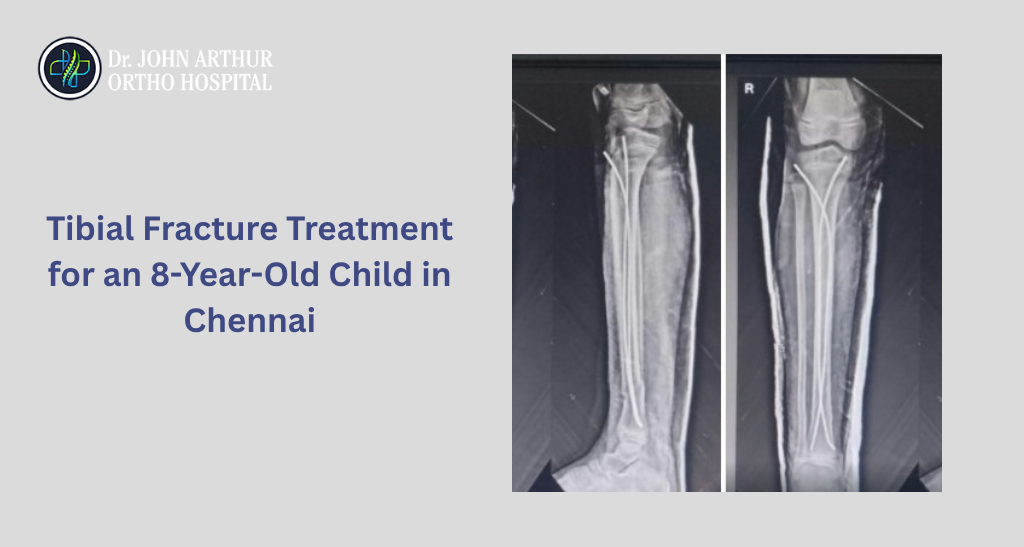
A fracture in a growing child requires careful evaluation and appropriate treatment to support bone healing while allowing the child to return to normal activities. In certain cases, particularly when the fracture is significantly displaced or unstable, surgical stabilisation may be considered.
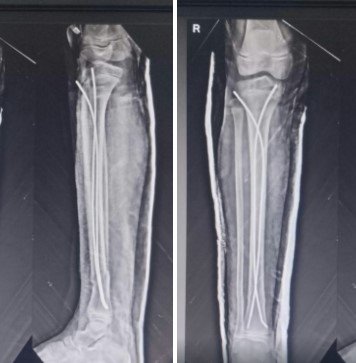
At Dr. John Arthur Ortho Hospital, Avadi, an 8-year-old child was brought in with a visibly deformed and unstable leg following an injury. The child was diagnosed with a tibial fracture and underwent surgical stabilisation using a Titanium Elastic Nail System (TENS).
An Unstable Tibial Fracture in a Child
The child presented with a visibly deformed and unstable lower leg. Following clinical evaluation and imaging, a fracture involving the tibia was identified.
Tibial fractures are among the important long-bone injuries seen in children. While many childhood fractures can be managed with immobilisation, some fractures may require surgical intervention depending on factors such as:
- Fracture displacement
- Stability of the fracture
- Deformity
- Location and pattern of the fracture
- The child’s age
- Associated injuries
- Ability to maintain proper alignment with non-surgical treatment
In this case, the fracture was considered unstable and required stabilisation.
Titanium Elastic Nail System for Paediatric Fractures
The fracture was treated using a Titanium Elastic Nail System (TENS), also known as elastic stable intramedullary nailing.
TENS uses flexible nails placed within the bone to provide internal support and help maintain alignment of the fractured bone during healing.
This technique is used in selected paediatric long-bone fractures because it can provide stability while being designed with the needs of growing children in mind.
The treatment approach is determined by the orthopaedic surgeon based on the child’s age, fracture pattern, location and stability.
Why Is Fracture Stabilisation Important in Children?
Maintaining appropriate alignment is an important part of treating an unstable fracture.
Appropriate stabilisation can help:
- Maintain fracture alignment
- Support the healing process
- Reduce the risk of persistent deformity
- Allow appropriate mobilisation when advised
- Help the child gradually return to normal activities
Children have considerable bone-healing potential, but unstable or significantly displaced fractures still require careful assessment and management.
Recovery After Paediatric Tibial Fracture Surgery
Recovery following fracture fixation varies depending on the child’s age, fracture pattern, treatment method and individual healing response.
After surgery, the child may require:
- Follow-up X-rays
- Wound and surgical-site care
- Activity restrictions
- Gradual weight-bearing as advised
- Rehabilitation when required
- Regular orthopaedic follow-up
Parents should follow the treating surgeon’s instructions regarding walking, sports, school activities and other physical activities during the recovery period.
A Step Towards Getting Back to Childhood Activities
The goal of treating a child’s fracture is not only to allow the bone to heal but also to help the child safely return to normal childhood activities.
With appropriate treatment, monitoring and rehabilitation when necessary, children can progressively work towards regaining normal function.
In this case, the child is now recovering and moving one step closer to getting back to everyday childhood activities.
Paediatric Fracture Treatment at Dr. John Arthur Ortho Hospital, Avadi
Dr. Peter Ponniah Jesudass, Orthopaedic & Joint Replacement Surgeon at Dr. John Arthur Ortho Hospital, Avadi, provides evaluation and treatment for fractures and other orthopaedic conditions.
The hospital provides orthopaedic care for children and adults, including the assessment and management of fractures, trauma and other musculoskeletal injuries.
If your child has suffered a significant injury, visible deformity, severe pain or difficulty moving the affected limb, prompt medical evaluation is important.
Looking for Tibial Fracture Treatment in Chennai?
A visibly deformed or unstable limb following an injury should be evaluated by an orthopaedic specialist as soon as possible. The appropriate treatment depends on the child’s age, fracture pattern, stability and overall condition.
Dr. John Arthur Ortho Hospital
Ground Floor, 182, Poonamallee–Avadi High Road, JB Estate, Avadi, Chennai – 600054
Call / WhatsApp: 73059 89799
Frequently Asked Questions
Can a tibial fracture in a child require surgery?
Yes. While many children’s fractures can be treated without surgery, significantly displaced or unstable fractures may require surgical stabilisation.
What is TENS fixation?
TENS stands for Titanium Elastic Nail System. It uses flexible intramedullary nails to stabilise selected long-bone fractures, particularly in children.
How long does a child’s tibial fracture take to heal?
Healing time varies depending on the child’s age, fracture type, location and treatment. The treating orthopaedic surgeon can provide a more specific recovery timeline based on follow-up assessments and X-rays.
Can children return to sports after a tibial fracture?
Children may gradually return to sports after the fracture has adequately healed and the treating doctor confirms that it is safe. The timing varies from case to case.
When should a child with a leg injury see an orthopaedic doctor?
A child should receive prompt medical assessment if there is severe pain, swelling, inability to bear weight, significant deformity or difficulty moving the affected limb.